
What Is CPA Marketing and How Does It Work?
CPA marketing pays for actions, not clicks or impressions. Learn how it works, what offers exist and how beginners can start safely.

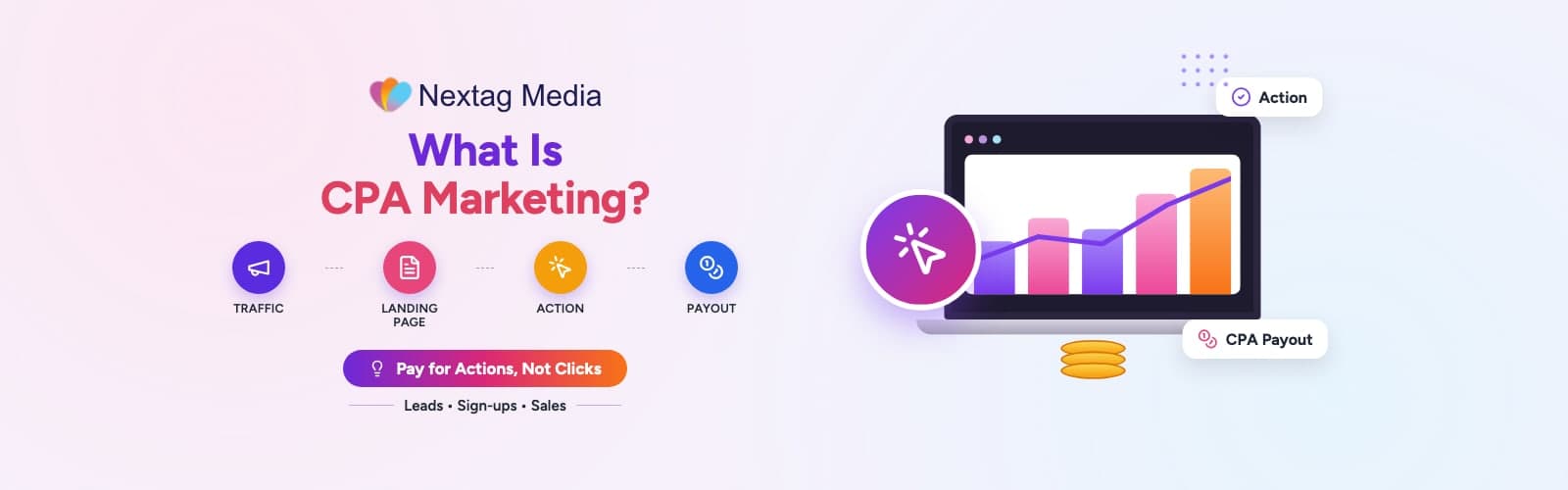
CPA (cost per action) marketing is a performance model where an advertiser pays a publisher only when a user completes a specific action, such as a sign-up, a form submission, a free trial, an app event or a purchase. For advertisers it means paying for results; for publishers it means earning per completed action instead of per click.
Key takeaways
- The "action" is defined by the advertiser and written in the offer terms.
- CPA covers many actions: leads, trials, deposits, installs with events, sales.
- Traffic quality matters; invalid actions are rejected.
- Start with one offer, one traffic source and careful tracking.
How CPA marketing works
- The advertiser lists a CPA offer with payout, target countries and allowed traffic.
- A publisher gets a tracking link from a network or program.
- The publisher sends traffic using content, email, ads or social.
- The user completes the action.
- The conversion is tracked (ideally via postback), validated and paid.
Common CPA offer types
| Offer | Action |
|---|---|
| Lead generation | Form submission (CPL is a type of CPA) |
| Free trial | Trial sign-up |
| Finance | Account opening, card application, deposit |
| App | Install plus registration or first purchase |
| E-commerce | First order |
Traffic sources for CPA
- SEO content and comparison pages
- Email newsletters
- Paid search, social and native ads (follow offer rules)
- Push and display where allowed
- Communities and creators
Always check which traffic sources each offer allows.
How to start CPA marketing
- Pick a vertical you understand.
- Join a reputable CPA network. See Top High Paying CPA Networks.
- Choose one offer that matches your audience.
- Build or use a high-converting landing page. See Best Landing Pages for CPA.
- Test with a small budget and track every sub ID.
Mistakes to avoid
- Sending traffic sources the offer does not allow.
- Scaling before tracking is verified.
- Choosing offers only by payout, ignoring conversion rate.
Conclusion
CPA marketing aligns everyone around results. Learn the offer terms, send relevant traffic and track carefully. Compare models in CPA vs CPL vs CPS.
Ready to run CPA offers?
Join thousands of publishers monetizing their audience with NextagMedia.
Frequently Asked Questions
Cost per action (sometimes cost per acquisition): the advertiser pays when a defined action happens.
CPA is a payment model used widely in affiliate marketing. Affiliate marketing can also use CPS, revenue share and other models.
Yes, if beginners start small, follow offer rules and learn tracking first.
Usually after validation on set terms such as weekly or Net 30, by bank transfer or payment platforms.
Get Growth Insights in Your Inbox
Join thousands of marketers getting weekly affiliate & performance marketing insights.
No spam. Unsubscribe anytime.
Start Earning Today
Sign up in minutes and get access to hundreds of high-payout offers.

Performance Marketing Strategist
Anupam kumar a full-funnel performance marketing strategies that connect paid acquisition to affiliate and partnership channels. He has spent his career optimizing campaigns across search, social, and native platforms, with a particular focus on attribution modeling and budget allocation. Anupam writes frequently about the intersection of paid media economics and affiliate performance.
Comments
Related Articles
CPA vs CPL vs CPS
Three letters, three very different payout structures. Here is how CPA, CPL, and CPS compare and when to use each.
 Anupam Kumar
Best Landing Pages for CPA
A great CPA offer with a weak landing page still fails. Here is what actually drives conversions.
Anupam Kumar
Top High Paying CPA Networks
Higher CPA payouts are not random. Here is what separates premium-paying networks from the rest, and how to get accepted into them.
 Ryan Bennett
Affiliate Marketing Glossary
From CPA to smartlinks to chargebacks, this glossary breaks down the affiliate marketing terms you will encounter most often.
Anupam Kumar