
What Is a Postback URL? S2S Tracking Explained
Postback URLs are the most reliable way to record affiliate conversions. Learn how server-to-server tracking works, with a clear example and fixes for common errors.

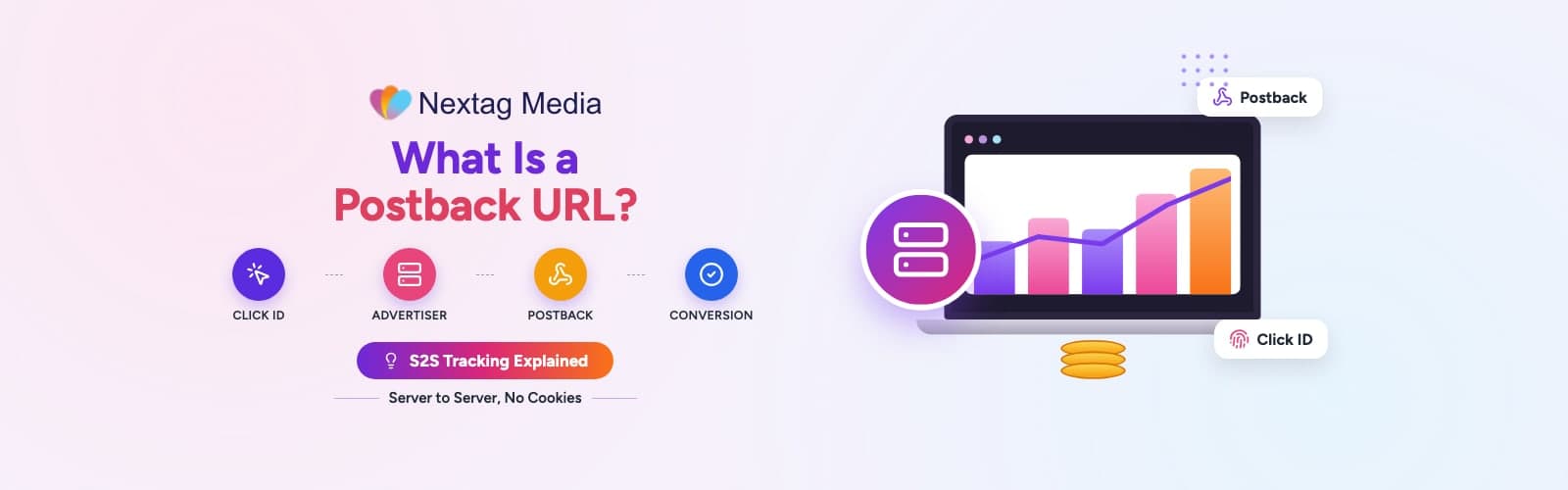
A postback URL is a link that the advertiser's server calls to tell the tracking platform that a conversion happened. It sends the original click ID, plus details such as payout and status, directly from server to server (S2S), without relying on the user's browser. That is why postbacks are the most reliable way to track affiliate conversions.
Key takeaways
- Postbacks match conversions to clicks using a unique click ID.
- Server-to-server tracking is not affected by cookie blocking or ad blockers.
- Macros (placeholders) pass dynamic values such as click ID and payout.
- Most postback problems come from a missing or altered click ID.
How postback tracking works
- Click: a user clicks an affiliate tracking link. The tracker records the click and creates a unique click ID.
- Redirect: the user is sent to the advertiser's landing page, with the click ID added as a URL parameter, for example
?click_id=abc123. - Store: the advertiser saves the click ID with the user's session or order.
- Conversion: the user buys, signs up or installs.
- Postback: the advertiser's server calls the tracker's postback URL with that click ID.
- Attribution: the tracker matches the click ID, records the conversion and, if set up, sends its own postback to the publisher.
Postback URL example
https://track.example.com/postback?click_id={click_id}&payout={payout}&status=approved&txn_id={order_id}The parts in braces are macros. The advertiser's system replaces them with real values when it fires the postback, for example click_id=abc123&payout=450&txn_id=ORD-7781.
Common parameters:
| Parameter | Purpose |
|---|---|
| click_id | Matches the conversion to the original click (required) |
| payout / sum | Conversion value or commission |
| status | Approved, pending or rejected |
| txn_id / order_id | Prevents duplicate conversions |
| goal / event | Which action happened (sale, lead, install, deposit) |
Postback vs tracking pixel
| Postback (S2S) | Pixel (browser) | |
|---|---|---|
| Fires from | Advertiser's server | User's browser |
| Blocked by ad blockers | No | Often |
| Depends on cookies | No | Usually |
| Setup effort | Needs developer work | Paste a code snippet |
| Reliability | High | Medium |
Pixels are quick to install but lose conversions when cookies are blocked or pages fail to load. Learn more in Tracking Pixels Explained.
Common postback errors and fixes
- Missing click ID: the landing page dropped the parameter during a redirect. Check every redirect keeps query strings.
- Wrong macro name: the advertiser used
{clickid}instead of{click_id}. Copy macros exactly from the tracker. - Duplicates: the postback fired twice. Pass a unique transaction ID so the tracker can deduplicate.
- Encoding problems: special characters in values break the URL. URL-encode dynamic values.
- Timing: some advertisers fire postbacks only after validation, so conversions appear later. Agree on status updates upfront.
Keeping postbacks secure
Anyone who knows a postback URL could try to send fake conversions. Protect it with a secret token in the URL, IP allowlisting for the advertiser's servers, or signed requests (HMAC), and monitor for unusual spikes. See Affiliate Fraud Prevention.
How to test a postback
- Click your own tracking link and note the click ID.
- Complete a test conversion, or fire the postback manually with that click ID.
- Confirm the conversion appears in the tracker with the right payout and status.
- Check the publisher postback was delivered, if you use one.
Conclusion
Postback URLs are the backbone of accurate affiliate tracking. Get the click ID flowing end to end, use the correct macros, deduplicate with transaction IDs and secure the endpoint. For the bigger picture, read Affiliate Tracking Explained.
Need help setting up reliable S2S tracking?
Join thousands of publishers monetizing their audience with NextagMedia.
Frequently Asked Questions
It is a URL the advertiser's server calls to report a conversion to the tracking platform, passing the click ID and details like payout and status.
A postback is sent server to server, while a pixel loads in the user's browser. Postbacks are more reliable because ad blockers and cookie restrictions do not affect them.
A unique identifier created for each click. It links the conversion back to the publisher, campaign and traffic source.
The most common causes are a missing click ID, a wrong macro name, a postback fired before the conversion was approved, or a blocked request. Test step by step from the click.
Get Growth Insights in Your Inbox
Join thousands of marketers getting weekly affiliate & performance marketing insights.
No spam. Unsubscribe anytime.
Browse High-Converting Offers
Find your next top-performing offer from our curated marketplace.

Performance Marketing Strategist
Anupam kumar a full-funnel performance marketing strategies that connect paid acquisition to affiliate and partnership channels. He has spent his career optimizing campaigns across search, social, and native platforms, with a particular focus on attribution modeling and budget allocation. Anupam writes frequently about the intersection of paid media economics and affiliate performance.
Comments
Related Articles
Tracking Pixels Explained
Tracking pixels are one of the oldest tools in affiliate tracking, and one of the most misunderstood. Here is how they actually work.
 Anupam Kumar
Affiliate Tracking Explained
Tracking is the invisible backbone of every affiliate commission. Here is exactly how it works, end to end.
Anupam Kumar
Cookieless Tracking: Affiliate Tracking Without Third-Party Cookies
Browsers block more cookies every year. Learn how cookieless tracking with postbacks and first-party data keeps affiliate conversions accurate.
Anupam Kumar
Attribution Models Explained for Affiliate Marketing
When a customer clicks several links before buying, who gets credit? Attribution models decide. Here is how each one works for affiliates.
Anupam Kumar