
Search Arbitrage Explained: How Search Feeds and RSOC Work
Search arbitrage buys traffic for less than it earns from search ads. Here is how search feeds and RSOC work, how to calculate profit and the rules you must follow.

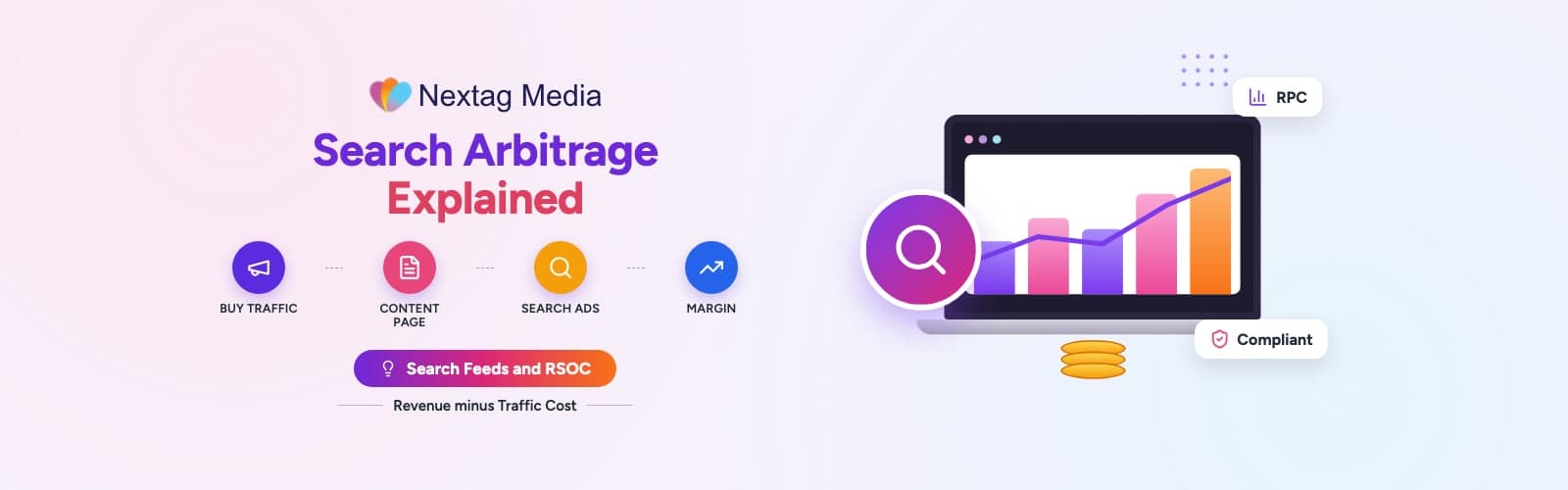
Search arbitrage is a performance marketing model where you buy traffic (for example from social or native ads) and send it to pages that show search ads. You profit when the revenue from people clicking those search ads is higher than what you paid for the traffic. It is usually run through search feed providers and formats such as RSOC (Related Search on Content).
Key takeaways
- Profit = search ad revenue minus traffic cost.
- Feed providers give you access to search ad inventory and pay a revenue share.
- RSOC places related search terms on content pages; clicking a term opens search results with ads.
- Strict platform and feed policies apply; poor compliance can end an account quickly.
How search arbitrage works
- Buy traffic from ad platforms such as Meta, TikTok, native networks or display.
- Land users on a page with useful content and related search terms, or a search box.
- User searches or clicks a related term, which opens a search results page served through a feed provider.
- User clicks a search ad on that page. The ad network pays the feed provider, which shares revenue with you.
- Compare revenue with traffic cost by campaign, keyword and placement, then scale the profitable ones.
What is RSOC?
RSOC stands for Related Search on Content. Instead of a bare search box, an article page shows a block of related search terms connected to its topic. When a reader clicks a term, they reach a search results page that includes ads. Done well, the content genuinely helps the reader and the search terms are relevant to what they are reading.
Key metrics
| Metric | Meaning |
|---|---|
| CPC (traffic) | What you pay per visitor from the ad platform |
| RPC / RPV | Revenue per click or per visitor from search ads |
| CTR to search | Share of visitors who click a related term or search |
| Ad CTR | Share of searchers who click an ad |
| ROAS / margin | Revenue divided by spend, or revenue minus spend |
Illustrative example (not real data): you pay ₹4 per visitor for 10,000 visitors (₹40,000). If search revenue is ₹52,000, your margin is ₹12,000 and ROAS is 1.3. If revenue drops below ₹40,000, the campaign loses money, so daily monitoring matters.
Compliance comes first
Search ad partners and ad platforms have strict policies. In practice this means:
- No misleading ad creatives or promises the landing page does not deliver.
- Content pages must offer real value, not just a wall of links.
- No incentivised clicks, forced redirects or hidden search terms.
- Follow your feed provider's rules on traffic sources, geos and page layout.
- Data from reports is often finalised later, so do not rely only on same-day estimates.
Accounts that break these rules can lose revenue or be closed, so build compliance into every campaign. See our Affiliate Compliance Guide.
Common risks
- Revenue lag: final revenue can differ from early estimates.
- Traffic quality: bots and accidental clicks reduce payouts and can trigger reviews.
- Platform changes: ad platform or feed policy updates can change margins overnight.
- Thin margins: small changes in CPC or RPC can flip profit to loss.
How to get started responsibly
- Learn one traffic source deeply before adding more.
- Work with an established feed provider or partner that explains its policies clearly.
- Start with small daily budgets and strict stop-loss rules.
- Reconcile spend and revenue daily, by campaign and keyword.
Conclusion
Search arbitrage can be profitable for disciplined media buyers who manage traffic quality, margins and compliance carefully. Treat it as a numbers business and reconcile every day. Learn how Nextagmedia approaches search monetization.
Have search traffic to monetise?
Join thousands of publishers monetizing their audience with NextagMedia.
Frequently Asked Questions
It is buying traffic at a lower cost than the revenue it generates through search ads, usually via a search feed provider.
RSOC means Related Search on Content: related search terms placed on an article page that lead to search results with ads.
Yes, when done within the policies of the ad platforms and search feed partners. Misleading creatives, incentivised clicks and low-value pages break those policies.
They earn a share of search ad revenue from feed providers and keep the difference between that revenue and their traffic costs.
Get Growth Insights in Your Inbox
Join thousands of marketers getting weekly affiliate & performance marketing insights.
No spam. Unsubscribe anytime.
Browse High-Converting Offers
Find your next top-performing offer from our curated marketplace.

Paid Media Director
Daniel oversees paid acquisition strategy across Google, Meta, and programmatic channels for NextagMedia and its affiliate partners. He has managed campaigns across multiple verticals and specializes in scaling spend profitably while protecting brand safety and platform compliance. Daniel is known for his data-driven approach to creative testing and bid strategy.
Comments
Related Articles

AI for Affiliate Marketing
AI is changing how affiliates test creative, optimize bids, and analyze traffic. Here is what actually works right now.
 Garima Singh
Performance Marketing Trends
From AI-driven bidding to first-party data, here are the shifts reshaping performance marketing in 2026.
 Anupam Kumar
Affiliate Conversion Optimization
Small, disciplined changes to your funnel usually beat one dramatic redesign. Here is a framework for testing what actually moves conversions.
Anupam Kumar
Performance Marketing vs Digital Marketing
Digital marketing is the big umbrella; performance marketing is the part that pays for measurable results. Here is how they differ and how to use both.
Anupam Kumar