
Influencer Marketing vs Affiliate Marketing
Influencers build awareness; affiliates drive measurable sales. Learn how the two models differ, when to use each and how hybrid deals combine both.

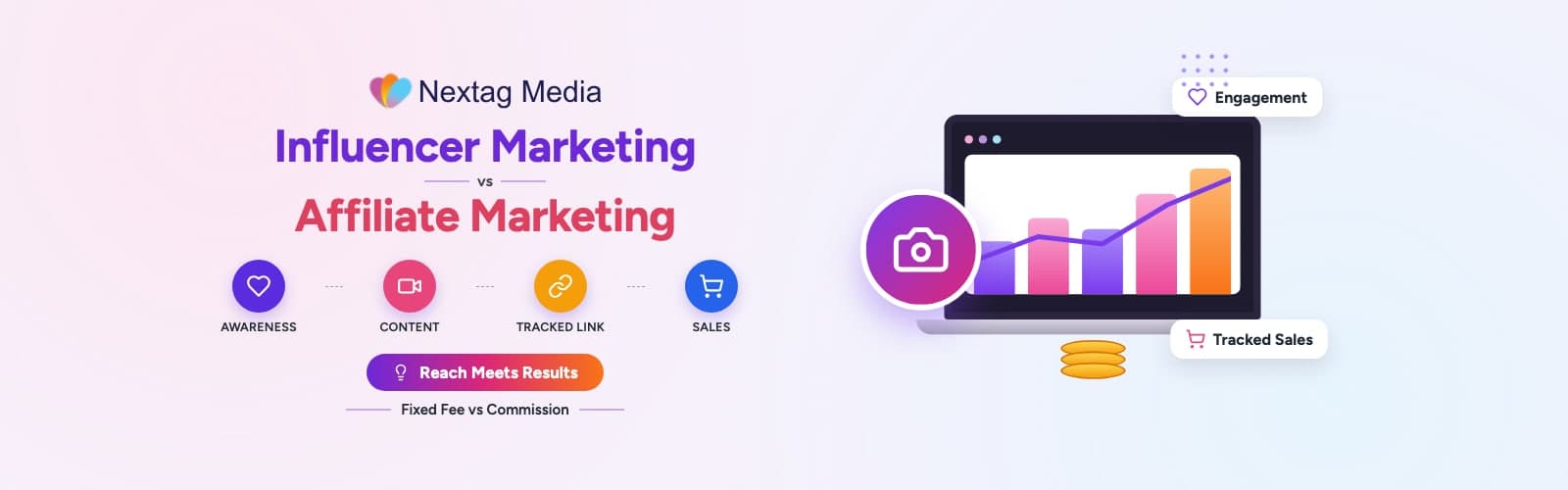
Influencer marketing pays creators to promote a brand, usually for a fixed fee, mainly to build awareness and trust. Affiliate marketing pays partners a commission only when a tracked sale, lead or action happens. Influencer marketing is about reach; affiliate marketing is about measurable results. Many brands now combine both.
Key takeaways
- Influencers: fixed fee, focus on awareness, harder to measure directly.
- Affiliates: performance-based payment, focus on conversions, easy to measure.
- Hybrid deals (small fee plus commission) share risk between brand and creator.
- Both require clear disclosure under ASCI (India) and FTC (US) rules.
Side-by-side comparison
| Factor | Influencer marketing | Affiliate marketing |
|---|---|---|
| Payment | Fixed fee per post or campaign | Commission per sale, lead or action |
| Main goal | Awareness, reach, brand trust | Sales, leads, installs |
| Measurement | Reach, engagement, brand lift | Clicks, conversions, revenue, EPC |
| Brand risk | Paid even if nothing sells | Pays only for results |
| Partner type | Creators with an audience | Content sites, creators, coupon, email, media buyers |
| Duration | Campaign-based | Always on |
When to choose influencer marketing
- Launching a new brand or product that people do not know yet.
- Entering a new market or audience segment.
- When content quality and storytelling matter more than immediate sales.
When to choose affiliate marketing
- When you want predictable cost per acquisition.
- Scaling proven products across many partners.
- When you need clear reporting by partner, channel and campaign. See Affiliate KPIs Explained.
The hybrid model: influencer affiliate programmes
Many brands now give creators a tracked affiliate link or code plus a smaller fixed fee. The creator is rewarded for the work of producing content, and the brand pays more only when content actually sells. Hybrid deals work well when:
- the creator's audience matches the product closely,
- tracking is reliable (links, codes and server-side postbacks), and
- commission terms, validation periods and disclosure rules are agreed in writing.
Disclosure rules
In India, ASCI guidelines require creators to clearly label paid and affiliate content. In the US, the FTC requires clear disclosure of material connections. Labels such as "Ad" or "Affiliate" should be easy to see, not buried in hashtags.
Conclusion
Influencer marketing and affiliate marketing are not rivals. Use influencers to build awareness and trust, use affiliates to turn that demand into tracked sales, and use hybrid deals when one creator can do both. Learn which payout model fits your goal in CPA vs CPL vs CPS.
Want creators and affiliates working for your brand?
Join thousands of publishers monetizing their audience with NextagMedia.
Frequently Asked Questions
No. Influencer marketing usually pays a fixed fee for promotion, while affiliate marketing pays commission only on tracked results. They can be combined.
Affiliate marketing is better for directly measurable sales. Influencer marketing is stronger for awareness that leads to sales over time.
Yes. Many creators use affiliate links or discount codes so they earn a commission on the sales they drive.
With unique tracked links, discount codes and server-side tracking such as postbacks, which tie each sale back to the creator.
Get Growth Insights in Your Inbox
Join thousands of marketers getting weekly affiliate & performance marketing insights.
No spam. Unsubscribe anytime.
Browse High-Converting Offers
Find your next top-performing offer from our curated marketplace.

Content & Growth Manager
Garima drives content strategy and growth initiatives for NextagMedia's affiliate and advertiser audiences, blending editorial craft with conversion-focused thinking. She has built content programs that support SEO, lead generation, and brand authority at the same time. Garima enjoys translating complex affiliate marketing concepts into practical, actionable guidance for publishers and advertisers alike.
Comments
Related Articles
Email Marketing Guide
An owned email list is one of the most durable assets an affiliate can build. Here is how to grow and monetize one properly.
 Garima Singh
Performance Marketing Trends
From AI-driven bidding to first-party data, here are the shifts reshaping performance marketing in 2026.
 Anupam Kumar
How Much Do Affiliate Marketers Make?
Affiliate income ranges from nothing to a full-time business. Instead of hype, this guide shows exactly how earnings are calculated and what moves the numbers.
 Priya Sharma
Top High Paying CPA Networks
Higher CPA payouts are not random. Here is what separates premium-paying networks from the rest, and how to get accepted into them.
 Ryan Bennett